AI World Cup Prediction: How to Predict the 2026 World Cup Winner with AI
The 2026 World Cup will kick off in Mexico City on June 11. For fans in Japan, the opening match will take place in the early hours of June 12.
Before the tournament begins, predicting the winner is not only about comparing the strength of each national team. Group-stage matchups, likely scorelines, and match-by-match results also matter. By looking at which teams are likely to collect points and which groups could become highly competitive, it becomes easier to build a more realistic AI World Cup prediction.
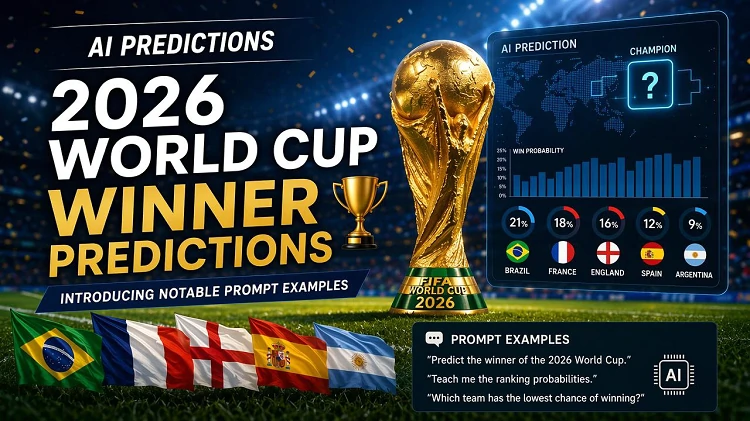
In this article, we will show you how to use ChatGPT, Gemini, and Grok to predict group-stage scores and match results, while also referring to publicly available title probability data. At the end, we will also introduce a bonus idea: using SeaArt AI to create World Cup prediction cards.
What Is an AI World Cup Prediction?
An AI World Cup prediction uses information such as team strength, publicly available winning probabilities, match schedules, fixtures, travel conditions, and recent form to estimate potential winners and tournament outcomes.
In this guide, we focus especially on group-stage match predictions, including win/loss results and expected scores for each game. By analyzing matches one by one, you can better understand which teams are more likely to advance from the group stage and which sides may have an advantage in the knockout rounds.
Of course, AI cannot accurately predict every match result. Injuries, red cards, penalties, weather, coaching decisions, and player condition on match day can all change the outcome. An AI World Cup predictor should be used as a helpful reference for understanding key storylines before watching the games.
Top Contenders for the 2026 World Cup
Before making score predictions for individual matches, it helps to review publicly available title probability data. This gives you a clearer sense of the overall competitive landscape.
According to the OPTA winning probability data introduced by Soccer King, Spain, France, England, and Argentina are among the leading contenders. Portugal, Brazil, and Germany are also listed as strong candidates.
However, these probabilities do not determine the actual winner. In the tournament itself, many factors can change the result, including group-stage order, knockout bracket paths, player fitness, travel distance, red cards, penalties, and other unpredictable moments.
Countries Ranked Highly in Public Data
According to OPTA’s World Cup winning probabilities, the leading teams are introduced as follows:
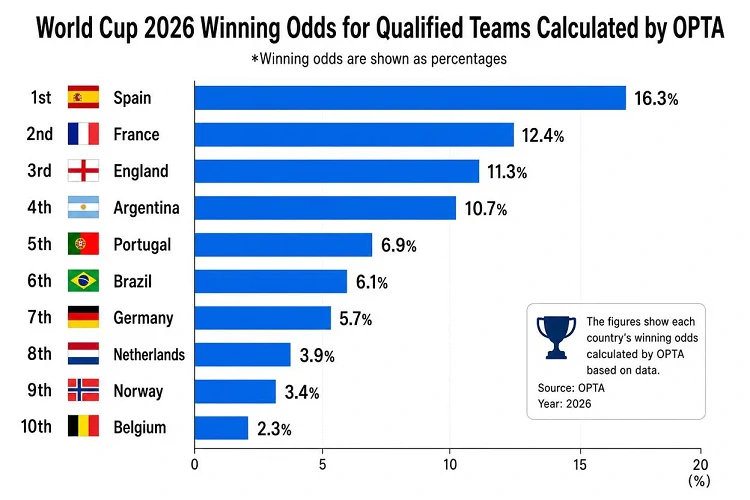
This ranking shows that Europe and South America remain the main power centers. Spain, France, England, and Argentina are useful benchmark teams when using AI to predict match-by-match scores.
At the same time, teams such as Portugal, Brazil, Germany, and the Netherlands may be rated differently depending on fixtures and tournament conditions. When using an AI World Cup simulation, it is better to include not only title probabilities but also head-to-head style, schedule, travel, and recent performance.
Japan is listed 19th with a 1.2% winning probability, the highest among Asian teams. If you want to make match-by-match predictions for Japan, enter the fixtures in Group F and ask AI to estimate each result and scoreline. This can help you understand Japan’s chances of reaching the knockout stage.
3 Ways to Predict 2026 World Cup Match Results with AI
Now let’s look at how to use ChatGPT, Gemini, and Grok to predict group-stage results. The main focus will be match winners, win probability, draw probability, and predicted scores.
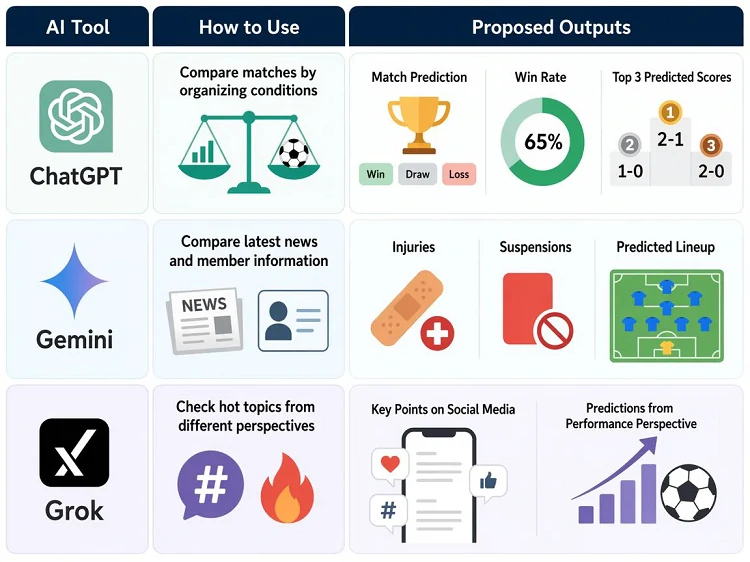
ChatGPT is useful when you want to organize conditions and compare teams. Gemini is helpful when you want to include recent news and up-to-date information. Grok can be useful when you want to consider social media trends while still separating hype from actual team strength.
No matter which AI tool you use, it is more realistic to ask for several possible scorelines instead of one fixed score. Injuries, suspensions, starting lineups, and weather can all change the prediction before kickoff.
Prompt for Predicting Match Scores with ChatGPT
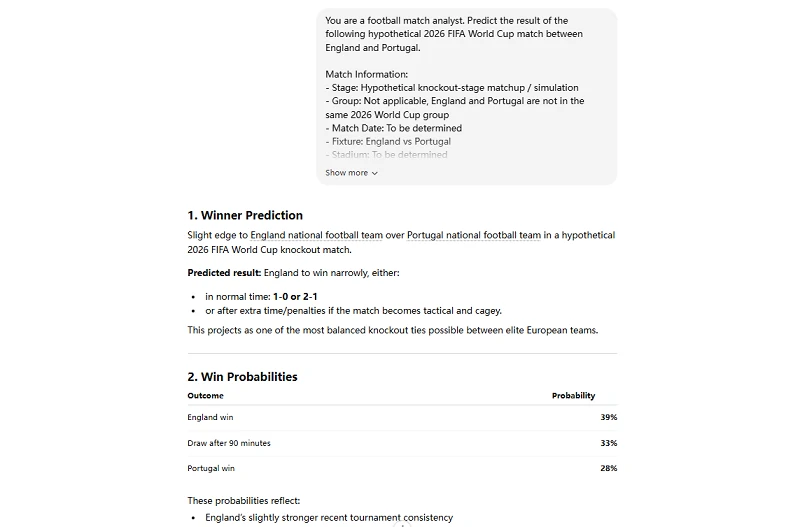
ChatGPT is especially useful when you want to organize match information and generate a structured score prediction. If you include the team names, group, match date, recent form, and key player conditions, ChatGPT can explain not only the predicted result but also the reasoning behind it.
1Example:
Prompt for Predicting Scores with Gemini Using Latest Information
Gemini is useful when you want to include pre-match news and squad information. If you can check injuries, suspensions, and expected starting lineups, Gemini can reflect those factors in the score prediction.
2Prompt for Match Predictions with Grok and Social Trends
When using Grok, ask it to consider social media discussion separately from actual team performance. This helps avoid overvaluing teams simply because they are trending online.
3Things to Remember When Using AI to Predict World Cup Scores
When using AI to predict World Cup scores, it is important not to treat the result as confirmed information. Football can change with a single goal, so even a detailed world cup predictor 2026 analysis still includes uncertainty.
Score Predictions Are Not Guaranteed Results
AI score predictions do not guarantee the final result. Even if you enter public winning probabilities and team data, the actual match may unfold differently.
This is especially true in the World Cup. Injuries, red cards, penalties, weather, travel, coaching decisions, and player condition can all have a major impact. In the group stage, match strategy may also change depending on the current points table.
Update Predictions with the Latest Information
Pre-match information can change until shortly before kickoff. Key player fitness, suspensions, expected lineups, and recent match results may all affect AI score predictions.
Instead of treating one prediction as final, update your prompts as the match gets closer. After group-stage results are available, add points, goal difference, and previous match outcomes to improve the next prediction.
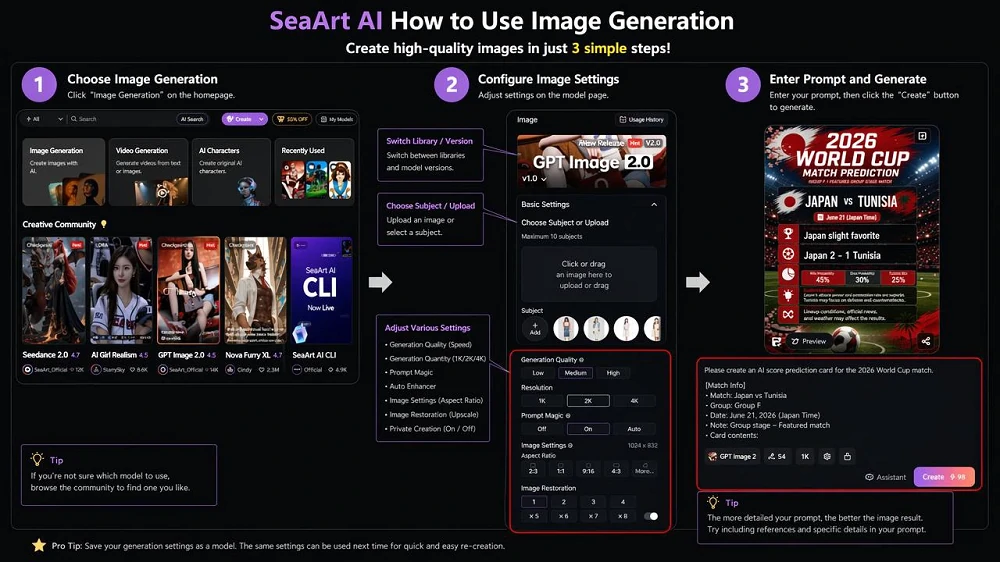
Bonus: Create AI Score Prediction Cards with SeaArt AI
After using ChatGPT, Gemini, or Grok to predict match scores, you can turn the results into card-style images with SeaArt AI.
Text-based analysis is useful for detailed reasoning, but it can be harder to read on blogs or social media. A score prediction card makes it easier to show the fixture, predicted score, win probability, and key talking points in one image.
With SeaArt AI, you can save generated images for free without watermarks. It is a practical tool for creating pre-match social posts, blog thumbnails, and fan support cards.
5Conclusion
When using AI for a 2026 World Cup prediction, it is better to start with match-by-match results and scores instead of simply asking who will win the tournament. By including group-stage fixtures, recent form, key player condition, schedule, and travel factors, you can create a more specific and realistic prediction.
ChatGPT works well for structured score predictions, Gemini is useful for analysis based on recent information, and Grok can help separate social media buzz from actual team strength. Still, AI predictions are not guaranteed results. Injuries, red cards, penalties, weather, and match-day condition can all change the outcome.
By building your AI World Cup prediction match by match, you can better understand the group-stage race and possible knockout-stage paths. With SeaArt AI, you can also turn predicted scores and win probabilities into visual score prediction cards. Use these tools to organize your thoughts before each match, create social posts, and enjoy the 2026 World Cup in a more interactive way.
Related Articles

I Tried the Ending Fairy AI Filter: How to Make a K-Pop Idol-Style Photo
How to Create a Baseball Broadcast AI Photo (With Prompts)

30 Mexico World Cup 2026 AI Prompts to Create Stunning Matchday Images

World Cup Poster Prompts: 38+ AI Ideas for 2026 Football Designs